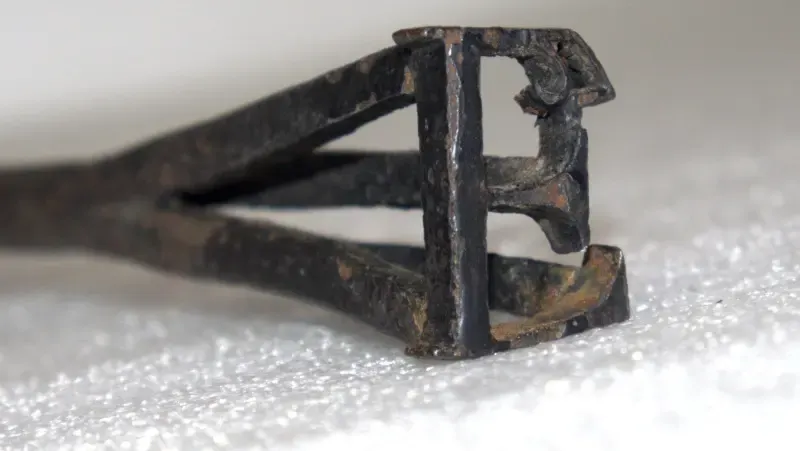
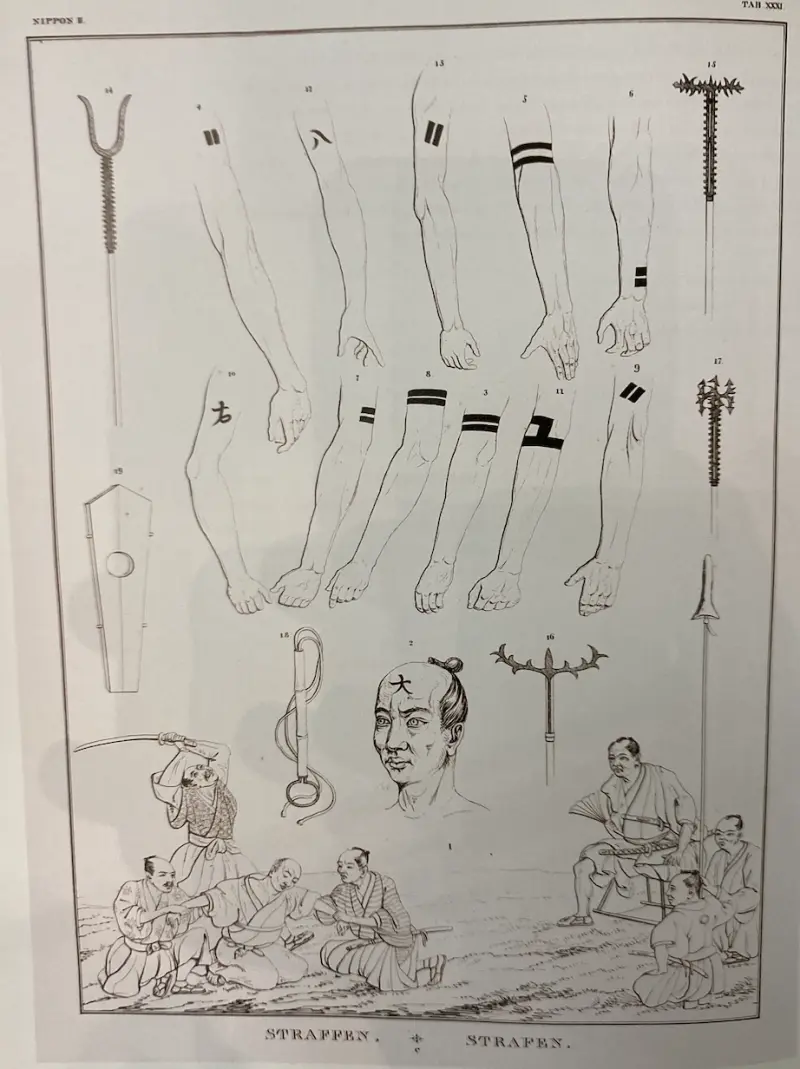
Many human societies used permanent, involuntary body markings to identify and exclude people. In ancient Greece and Rome, slaves or prisoners of war had marks branded or tattooed onto their bodies. In Japan during the Edo period (1603–1868), criminals were punished with theirezumi kei: murderers received a tattoo on their head, thieves on their arm. In the West, too, prisoners or deserting soldiers were marked with punishment marks on their bodies. This violation of bodily integrity drew criticism, but the practice continued into the 19th century.
During World War II, the Nazis used the marking of entire population groups as a way to identify and exclude them. This was done with symbols on clothing, such as the Star of David. At Auschwitz, the largest Nazi extermination camp, tattoos were soon introduced. In 1941, prisoners of war from the Soviet Union were given a number on their chest. Starting in 1943, all prisoners had a number tattooed on their forearm and sometimes a symbol as well: Jews received a triangle, Roma a “Z.”
Survivors often had their camp numbers removed after the war. Not Regine Beer, one of the few who returned from Auschwitz. She testified about the horrors of the persecution of the Jews. She kept her blue tattoo with the number A 5148 as a memento and as evidence of the unthinkable horror of Auschwitz. That is why, after her death in 2014, she bequeathed her tattoo to the Kazerne Dossin Museum in Mechelen.

Amnesty International reports that even today, some regimes use tattoos to mark prisoners. In 2005, a U.S. congressman even proposed tattooing people infected with HIV so they could be identified …
This story was created by Geheugen Collectief for FAAM – Virtual Museum.
 ErfgoedApp
 ErfgoedApp
 ErfgoedApp