Life as it is, through a historical lens
“The past is a strange country, where things are done differently." This is how British novelist L. P. Hartley began his work The Go-Between. Anyone who actually gazes into that dizzying past soon realizes that this sentence contains as much truth as it does falsehood. Yes, things were different, but as in a primary school poem, the rhyme scheme often seems all too predictable. "History never repeats itself, but it always rhymes a little": that's more like it!
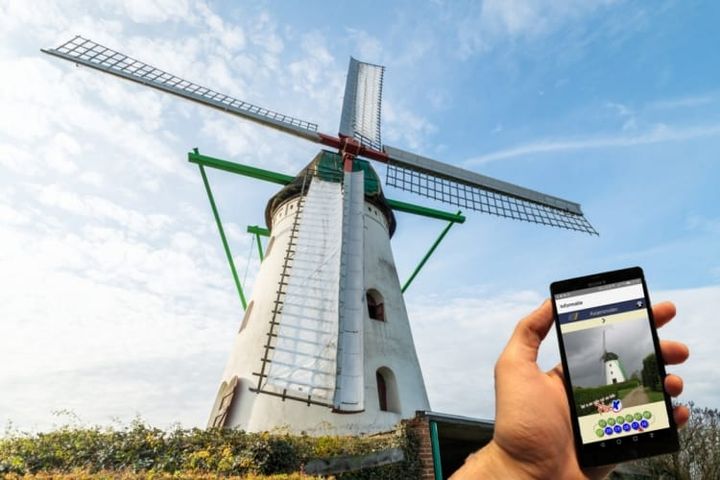
The ErfgoedApp a range of heritage walks that offer you a glimpse into that familiar past. The following tours present themselves as snapshots from the past. All of them are walks through a historic city with former residents as your guides. When you look at the black screen of your smartphone, you see yourself; ErfgoedApp you open one of these walks in the ErfgoedApp , you may still see yourself staring back at you.
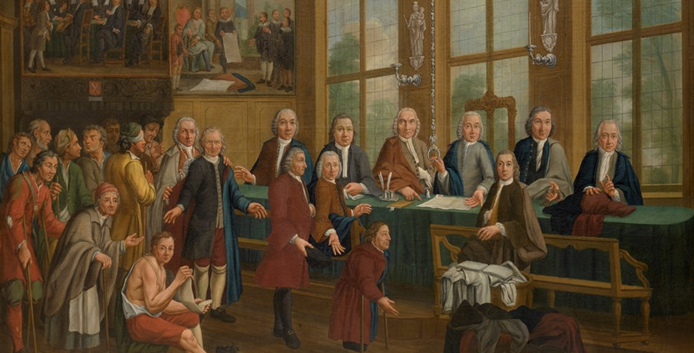
Out and about with an Almanac – Bruges Public Library
In September 2023, Bruges Public Library launched'Op Stap met een Almanak'(Out and Aboutwith anAlmanac) in the ErfgoedApp. This educational city walk was specially designed for secondary school students in the second grade. However, don't let that stop you from taking the tour even if you're not a student. The heart knows what the head wants, and the head wants to know things!
The tour starts at the Biekorf Main Library, where we are suddenly catapulted roughly two and a half centuries into the past. In the distant year of 1778, we encounter no power-hungry marquises or revolutionaries seeking justice. Instead, we encounter Andreas Kuipers, an ordinary boy who roams the late 18th-century city because of his father's daily tasks. Thanks to the library's historical collection, this journey through time is supported by an authentic city almanac. Almanacs such as this were published periodically and contained all the information that a Bruges resident needed at the time to live a fruitful daily life. From postal services to markets and public holidays to the closing times of the city gates (yes, in the past you could still justify spending the night in the city).
This source teaches us about exchange rates, postal delivery, visits to the pharmacy, and much more. In less than an hour, you will get to know the city as the 18th-century inhabitants of Bruges saw it. The Bruges Public Library even offers an activity booklet that will test your knowledge of the city even further. Once you arrive at the Grote Markt to recover from your adventure with a bag of fries or a Trappist beer in your hand, you may ask yourself: "Actually, not much has changed, has it?"
I, Jan Smeken – Brussels Heritage Cell
From Bruges to Brussels, then, and this time a little further back in time (where things are even more different, but still make a little sense). Here we follow Jan Smeken, the main character of the novel Ik Jan Smeken (I, Jan Smeken ), but above all a headstrong man. Jan Smeken was the resident city poet of Brussels, which had since become the capital, during the pivotal years between the Middle Ages and the early modern period (i.e., the turn of the fifteenth to the sixteenth century). Both authors of Ik Jan Smeken, Rick de Leeuw and Remco Sleiderink, guide you through Jan's Brussels, usually in Jan's own words. Thanks to modern retellings of Jan Smeken's poems, we get to know fifteenth-century Brussels as he knew it. We witness the execution of Slakke Warre, who caught snails and ate them raw, until Warre decided to start murdering people. We see Jan and his friends reenacting plays on the quays of the Senne, which at that time still flowed uncovered through the city. Executions on the Grand Place and a river running through the city center—it sounds as if the past really was another country. However, when snow falls on the streets of Brussels and we hear Jan Smeken describe the emerging snowmen, it all seems to fit together. Doesn't it?
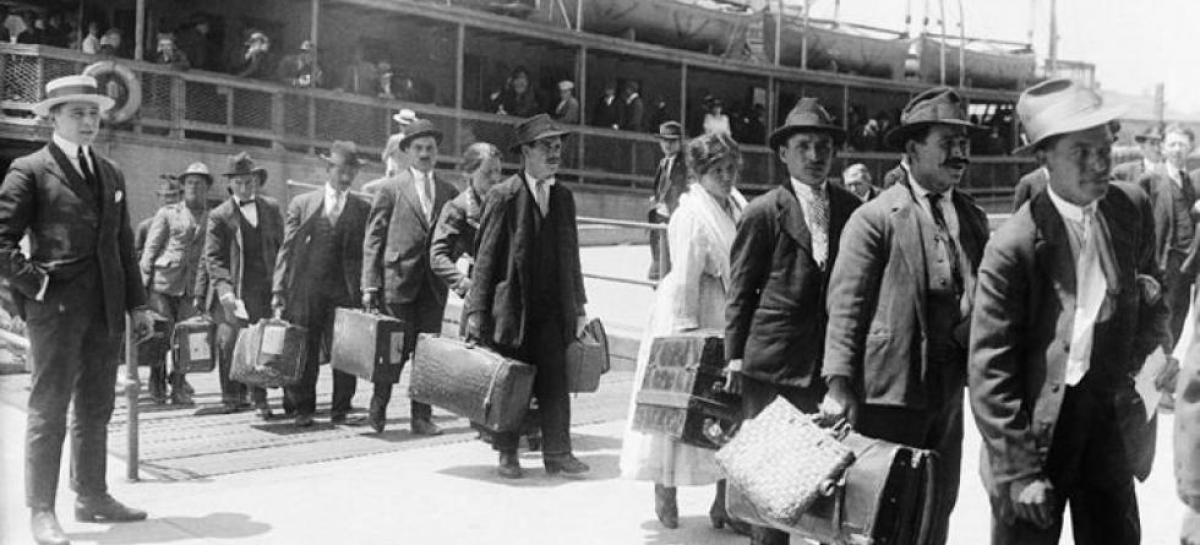
Walk from Central Station to the Red Star Line Museum – Red Star Line Museum
"I was seven years old and the train was filling up." That's how the tour of the Red Star Line Museum begins. In the midst of the hustle and bustle of Antwerp Central Station, we travel back a century and a half to that strange land we know as 'the past' and follow the stories of the countless emigrants, mainly from Central Europe, who in turn also ventured into an unknown world. Often with only the clothes on their backs, they arrived at Middenstation (Central Station) from all corners of Europe. They then made their way to the quays of Antwerp, where steamships of the Red Star Line would take them to the evocative America. Through historical video clips, we look behind the veil of time and come face to face with that past. This experience, leaving home to start a new chapter elsewhere, sounds all too familiar to many. What happened in the past was more than just the comfort of a day out in the city, winter fun, and amateur theater. More often than not, it was about the challenges that the world presents us with, and with that, the resilience of human beings.
Are you curious about what life was like in the past and the experiences of those who walked here centuries ago? Then be sure to try one of these, or many other, tours in the ErfgoedApp and discover for yourself how the past may be a strange land, but was not so different after all.