The Heuvelland and the region around Ypres were severely affected by World War I. The English writer Siegfried Sassoon gained worldwide fame with his anti-war poem“Memorial Tablet”—which includes the memorable lines “I died in Hell—(they called it Passchendaele).” Many soldiers who returned from the war suffered from shell shock or war neurosis, a specific form of post-traumatic stress disorder.
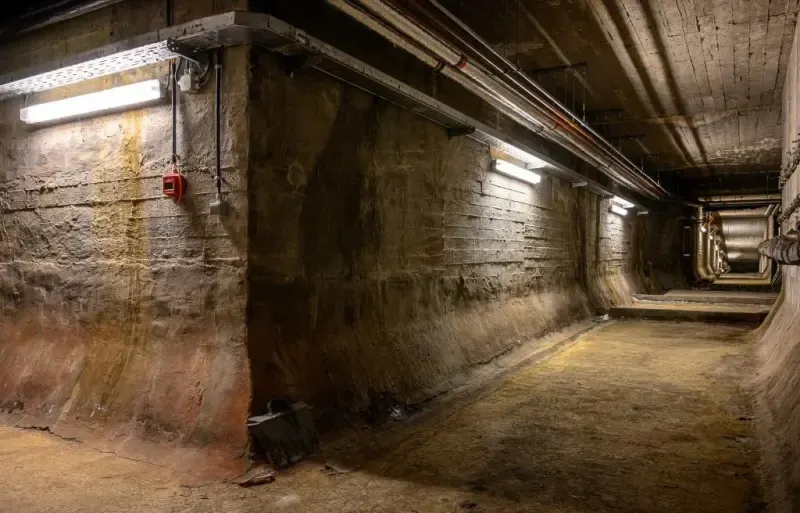
It is less well known that the Heuvelland also played an important role during the Cold War, the period following World War II that was dominated by fear of a nuclear war. For this reason, bunkers capable of serving as command centers were built in numerous locations throughout Western Europe. Senior military leaders and members of the government could be brought to safety there in the event of an attack by the enemy from the east—the communist Soviet Union and its allies in the Warsaw Pact.
In our country, the strategic bunker was built beneath the Kemmelberg. From 1952 to 1956, various teams worked on the underground complex, without the workers or local residents knowing exactly what was going on. Even after the end of the Cold War—with the fall of the Berlin Wall in 1989 and the collapse of the Soviet Union in late 1991—the true nature of the project remained a well-kept secret for a long time. It was not until the beginning of this century that the bunker’s existence and purpose were acknowledged.
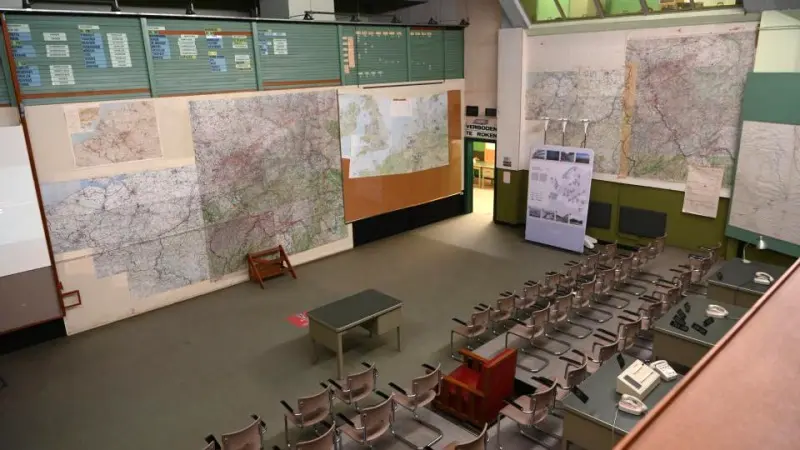
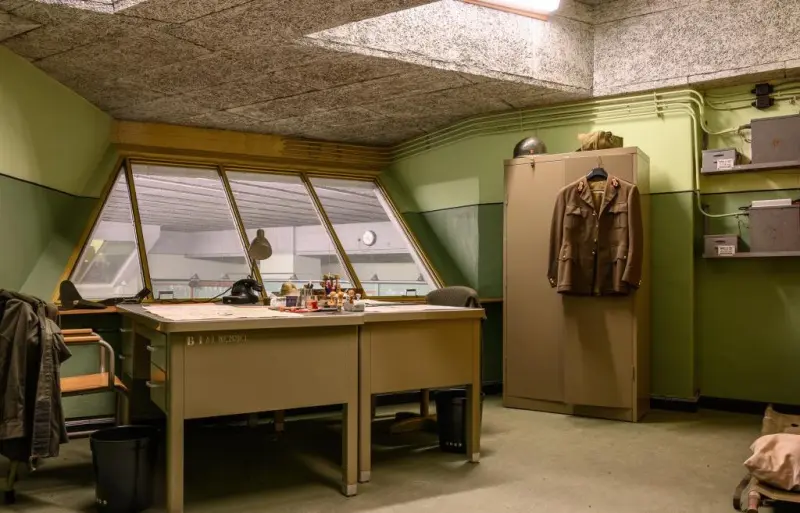
The bunker is an underground complex covering more than 2,000 m², spread over two floors. It was used until the mid-1990s, primarily for NATO exercises involving aircraft such as the Spitfire or Hawker Hurricane. However, because the command center became technically obsolete shortly after its construction, the bunker was never used for its intended purpose: as the command post for an international air defense system. Furthermore, despite its two-meter-thick walls and a location fifteen meters below ground, the complex proved insufficiently resistant to an attack involving nuclear, biological, or chemical weapons.
Since 2017, the bunker has been part of the War Heritage Institute, whose mission is to keep alive the memory of all the conflicts in which our country has been involved.
This story was created by OKV for FAAM—a virtual museum.
 ErfgoedApp
 ErfgoedApp
 ErfgoedApp
 ErfgoedApp