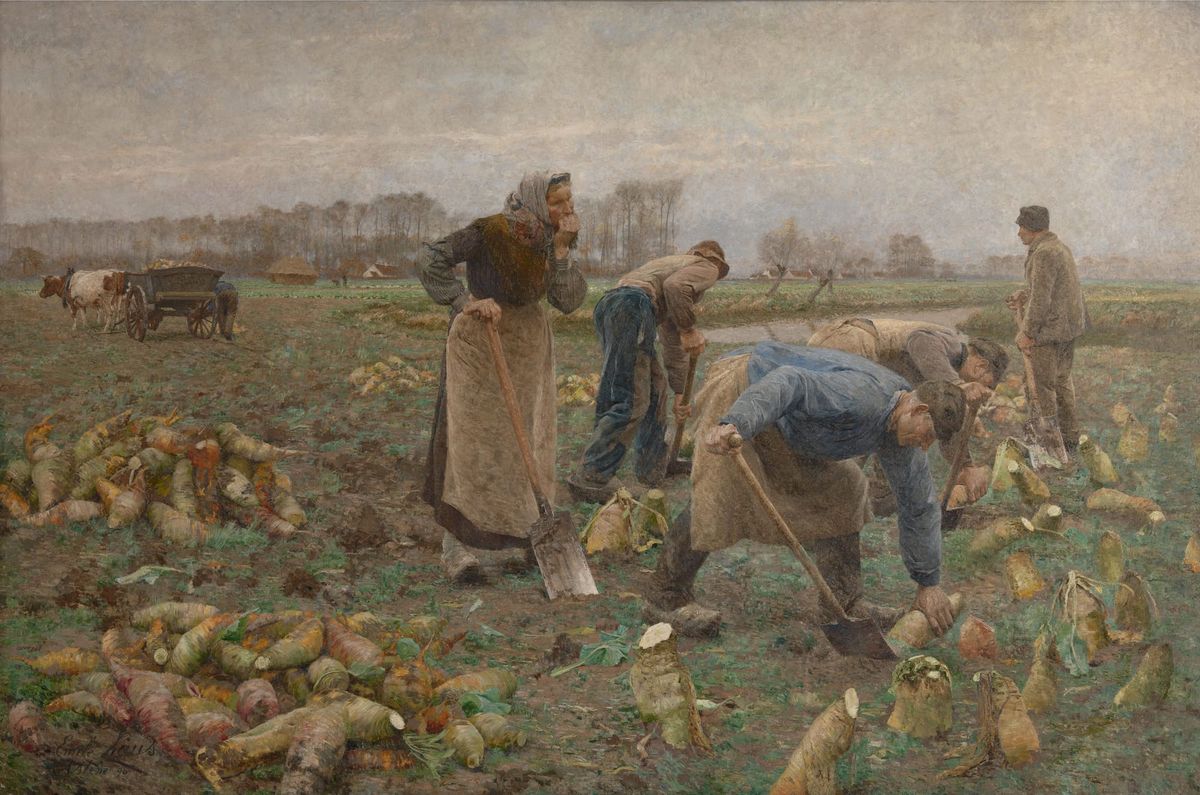
According to the legend behind*Beet Harvest*, the Impressionist painter Emile Claus set up a gigantic canvas in the fields near hisVilla Zonneschijnin the late 19th century to paint a scene of farmers harvesting beets. He is said to have then lowered the canvas into a ditch so he could reach the top of it. It is more likely, however, that he used photographs to finish the canvas in his studio. Many fin-de-siècle painters used this new medium as a kind of sketchbook.
In any case,*Beet Harvest* (1890) is an impressive rural scene. The painting depicts Henri Van Laere and Adèle Rogghe, a married couple from Astene (Deinze) on the Leie River. It is immediately apparent from the canvas just how arduous their manual labor is.
The History of Landscape Painting as a Genre
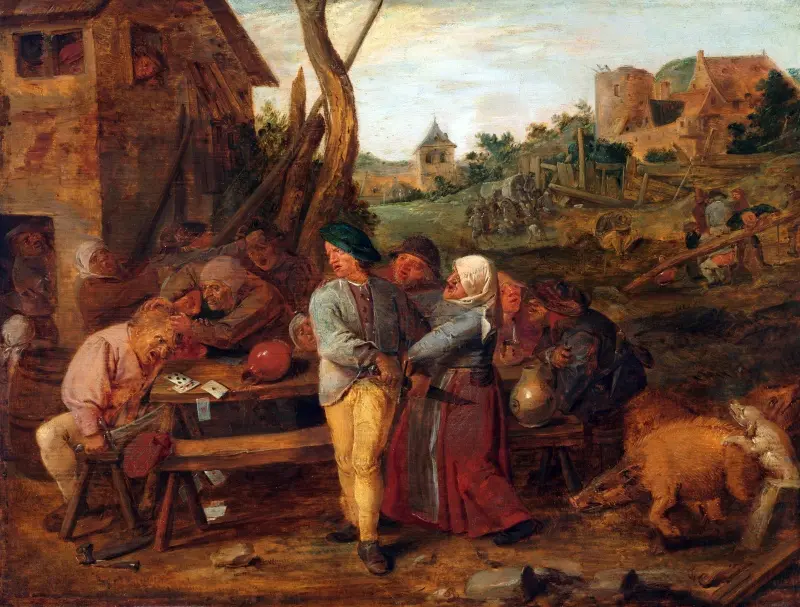
Claus did not invent landscape painting. Just think of medieval books of hours, or Pieter Bruegel the Elder’s peasant festivals, or Adriaen Brouwer’s*Peasant Brawl*(1620–1630). Eighteenth-century painting depicts more pastoral idylls than sweating farm laborers. In the nineteenth and early twentieth centuries, rural hardship once again became a theme. Painters such as Emile Claus literally placed the hardworking farmers in the foreground.
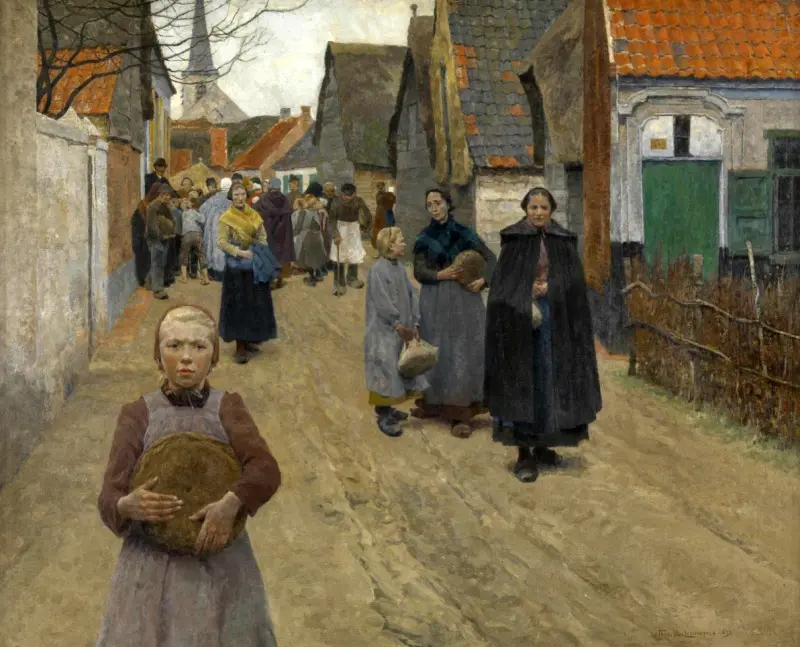
He wasn’t the only one. French painters such as Gustave Courbet and Jean-François Millet, as well as Vincent van Gogh in the Netherlands, had preceded him. In the Kempen region, Charles Wellens sought to capture the vanishing agricultural life of the Kempen through his paintings. Realists such as Frans Van Leemputten also painted farmers and their animals.
This story was created by Geheugen Collectief for FAAM – Virtual Museum.
 ErfgoedApp
 ErfgoedApp
 ErfgoedApp