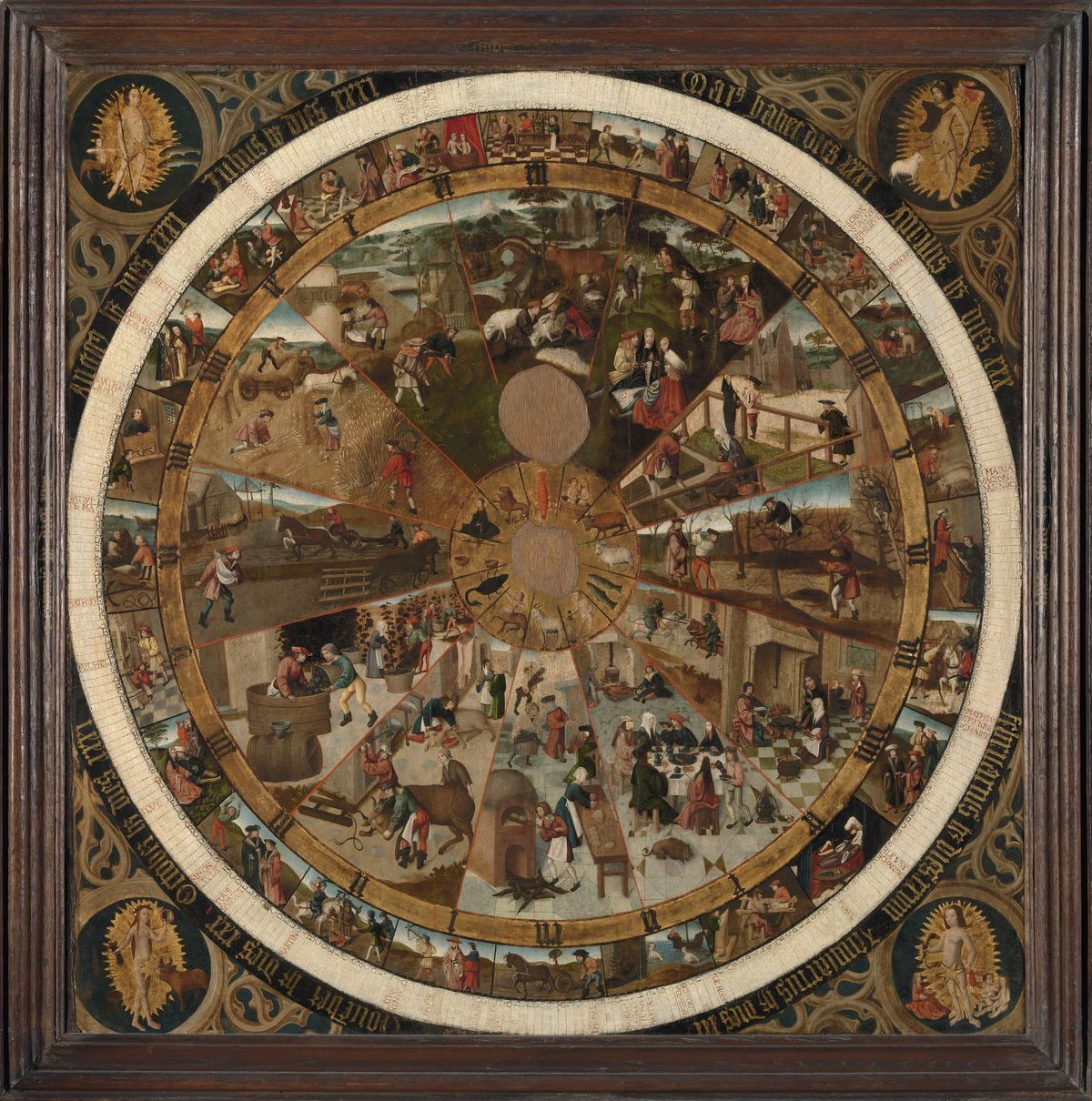
In 1938, Victor Demunter, the former curator of the Leuven City Museum, bequeathed his art collection to the museum. One of the highlights was a painted oak panel dating from around 1500. The hours, days, and months are depicted in six concentric circles, as are the 12 signs of the zodiac. Less well known are the 24 so-called “children of the planets”: the types of people, professions, and activities that, according to astrology, are associated with a specific planet. In the four corners of the panel, Jupiter, Mars, Venus, and Mercury are depicted in human form.
There must once have been a mechanism behind the dial that moved the hands. It is impossible to say with certainty who made the dial. In the past, without much evidence, it was thought to be the Leuven brothers Quinten and Joos Massijs. Joos was a blacksmith and clockmaker; Quinten was a well-known painter.
In the Middle Ages, time was not yet viewed as a straight line but as a circle.
The Leuven dial is a rare testament to the late medieval view of time and the world. At that time, time was not yet regarded as a straight line that began in the past and extended through the present into the future. In the Middle Ages, people believed that everything repeated itself: every moment of the day, every day of the year, and every season had a specific meaning that recurred time and again. Numbers, too, were imbued with symbolic significance. Time, humanity, nature, and the universe were all interconnected and influenced one another.
The depictions on the plate reflect the belief that the positions of the celestial bodies had an inescapable influence on people’s destinies. Anyone under the influence of Saturn, for example, was in for a world of trouble. Saturn was associated with hard labor, beggars, prisoners, the crippled, and the poor. Astrology existed as far back as antiquity, but it was particularly prominent in medieval iconography.
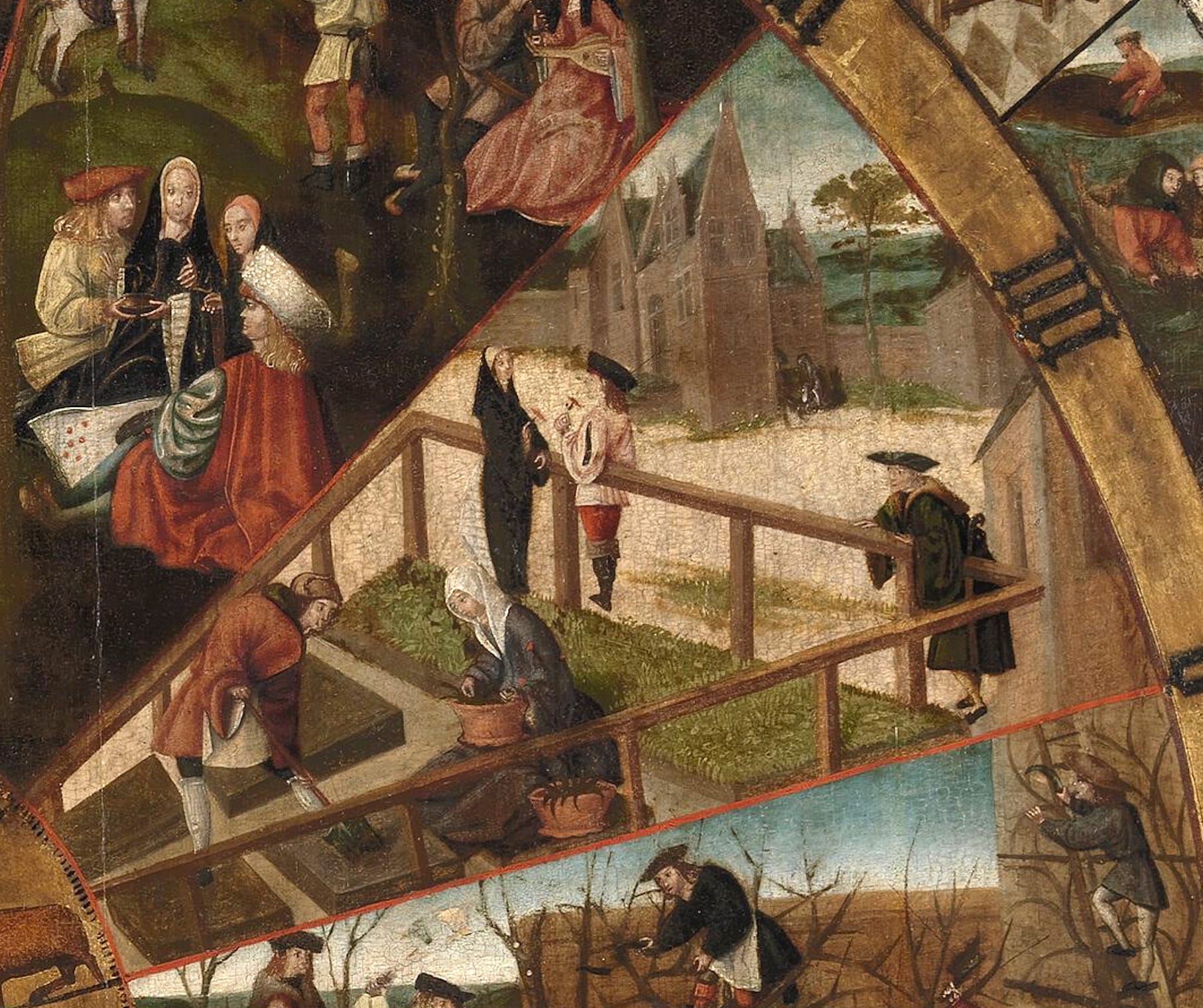
Thanks to its detailed paintings, the Leuven dial also offers a fascinating glimpse into life, traditional dress, and furniture in Brabant around 1500. It was likely commissioned by members of the nobility (inscriptions in French and Latin suggest this), but various social groups are depicted on it.
This story was created by Geheugen Collectief for FAAM – Virtual Museum.
 FAAM
FAAM
 FAAM
FAAM