In rural areas, for a long time it was necessary to be a jack-of-all-trades. Well into the 19th century, farming families had to make and repair their own tools, bake bread, sew clothes… Yet there were also specialized craftsmen in every village. They were indispensable to the farm. The blacksmith was one such person. He fitted horses with horseshoes and made tools and utensils. Or the miller, who ground grain and seeds.
The wheelwright as a pre-modern mechanic
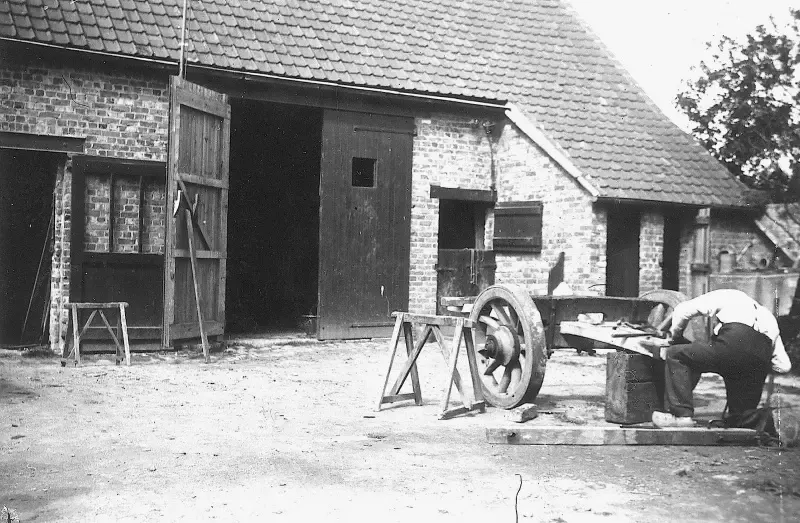
Many villages also had a wagon maker. In the days before motorized vehicles, he was the garage owner. He built and repaired carts, wagons, and wagon parts, such as wheels and axle blocks. Wood was his primary material. In rural areas, his clientele consisted largely of farmers, but he also worked for the brewer or the local nobility. He also made agricultural implements, sometimes in collaboration with the blacksmith.
The wheelwright as a wood specialist
The specialty that set the wheelwright apart from other woodworkers (such as cabinetmakers and carpenters) was wheel-making. That was difficult. He received his training on the job, often passed down from father to son. As a result, the wheelwright knew everything there was to know about types of wood such as elm, oak, and acacia. To earn extra income, some wheelwrights also did general carpentry work or ran—together with their wives—an inn or a small shop.
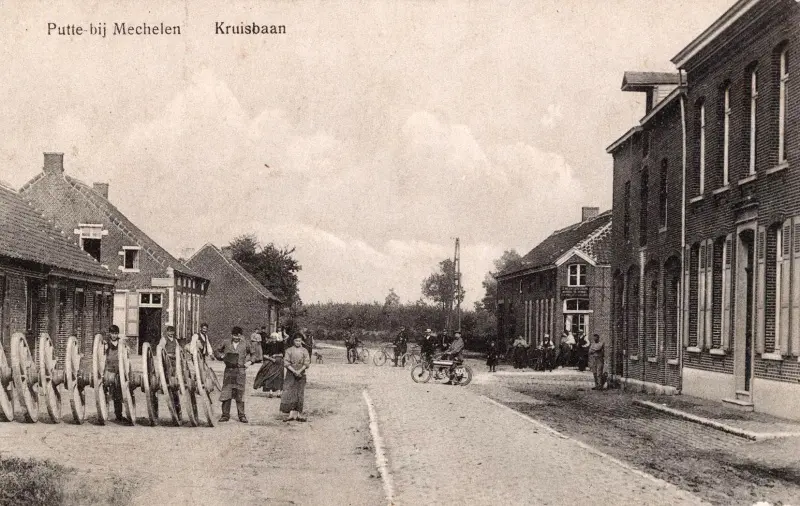
The wheelwright becomes a mechanic
In the second half of the 19th century, more and more drilling and sawing machines began to appear in workshops. Yet a great deal of manual labor was still involved. Until World War I, most villages still had at least one wheelwright’s shop. That number dwindled rapidly with the advent of the rubber pneumatic tire. Many wheelwrights retrained as body builders, carpenters… or mechanics.
This story was created by Geheugen Collectief for FAAM – Virtual Museum.
 ErfgoedApp
 ErfgoedApp
 ErfgoedApp
 ErfgoedApp