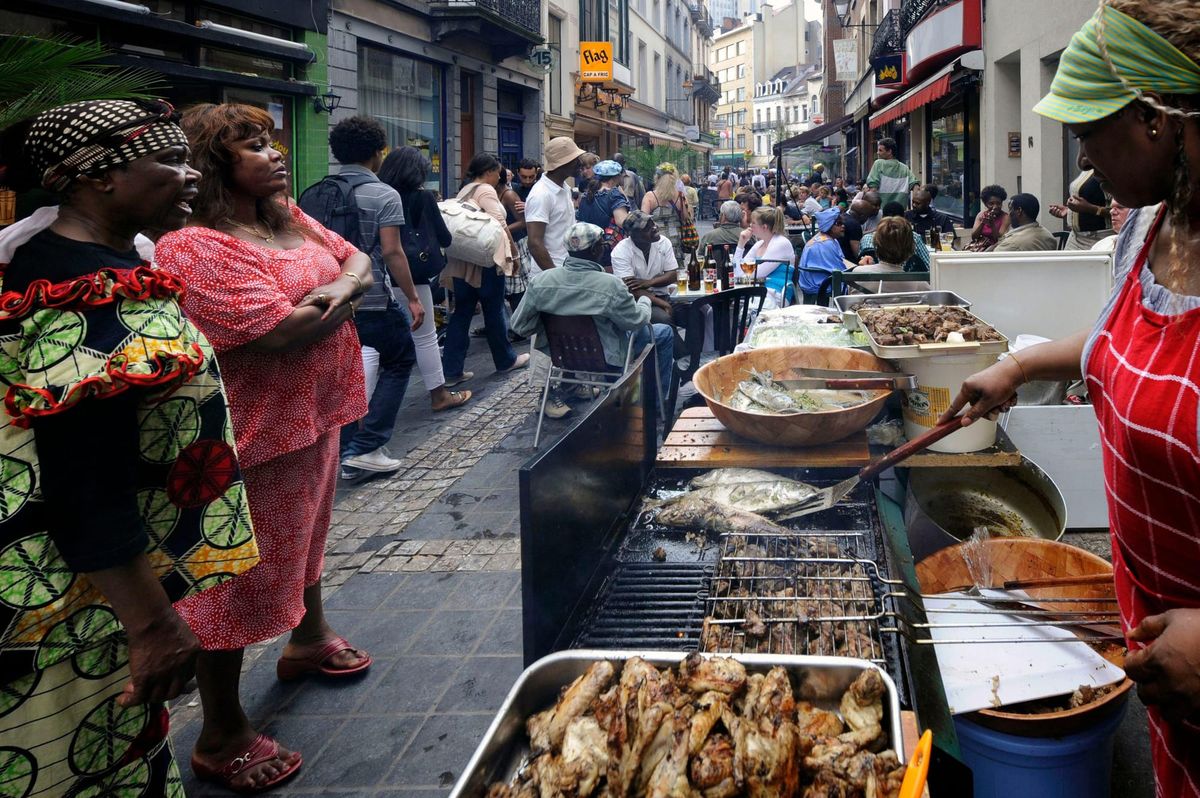
Matonge is a vibrant neighborhood in Ixelles, bordering the Brussels Pentagonal District. It covers just a few streets and has been associated with the Congolese diaspora since the 1950s.
But why are there actually relatively few people of Congolese, Rwandan, or Burundian descent living in Belgium? Why haven’t dishes from the former colony (or colonies) become established in Belgian cuisine, as they have in the Netherlands or the United Kingdom?
The first Congolese people to come to Belgium did not do so of their own free will. They were forced to serve as curiosities at world’s fairs in Antwerp (1885 and 1894), Brussels (1897), and elsewhere. Those “human zoos” continued to exist even after Belgium took over administration of the Congo from King Leopold II in 1908. Even at Expo 58, barely two years before Congolese independence, Congolese people were still being exhibited.
Starting in the late 19th century, a number of Congolese boys and girls were brought to Belgium to receive a Western education. A few sailors also settled in the country, and during World War I, 32 Congolese men enlisted in the Belgian army.
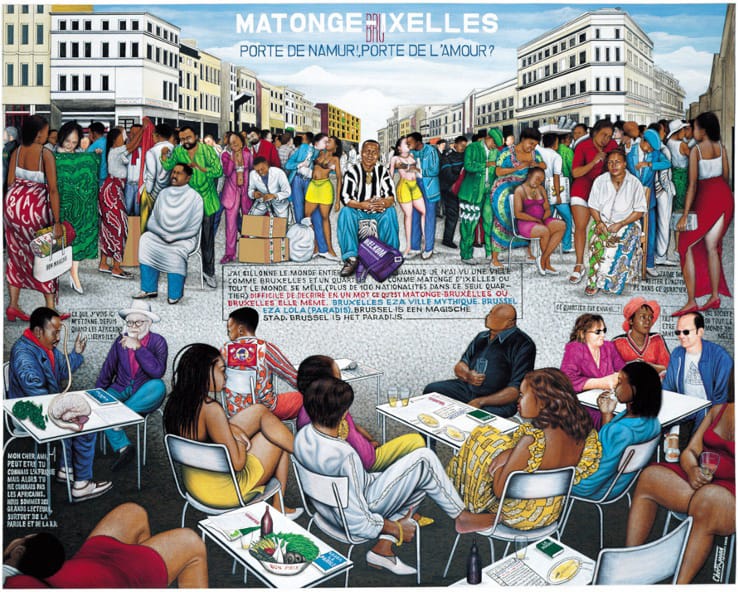
But the Belgian government certainly did not encourage immigration from the Congo. It was only after World War II that it began to allow, on a very limited basis, small, select groups of Congolese to come to the “motherland.” They were part of the so-called“évolués,”the emerging Europeanized Congolese elite. Footballers like Léon Mokuma and an increasing number of students also came to Belgium. The latter settled in Matonge, named after a neighborhood in Kinshasa. The first restaurants, hair salons, and nightclubs date back to that time.
After the Congo gained independence in 1960, the neighborhood remained a destination for immigrants from the Congo. Starting in 1965, the first political refugees—opponents of dictator Mobutu—began arriving. But the influx remained limited. Other European countries attracted proportionally more migrants from their former colonies. It was not until the 1990s, with the violence in the final years of Mobutu’s regime, that the Congolese diaspora grew rapidly.
Matonge has long since ceased to be an exclusively Congolese neighborhood—in fact, it never really was. But on June 30, Congo’s Independence Day, it’s still a festive place.
This story was created by Geheugen Collectief for FAAM – Virtual Museum.
 Tim Debroyer
 ErfgoedApp
 ErfgoedApp
 ErfgoedApp
 ErfgoedApp
 ErfgoedApp