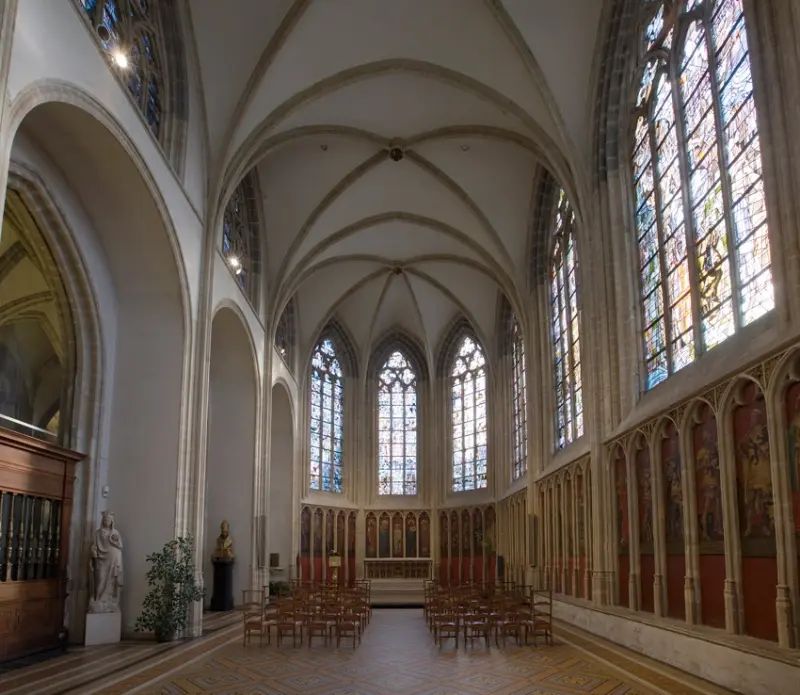
The Count's Chapel is part of the Church of Our Lady in Kortrijk. It was built in 1371 by the Flemish count Louis of Male.
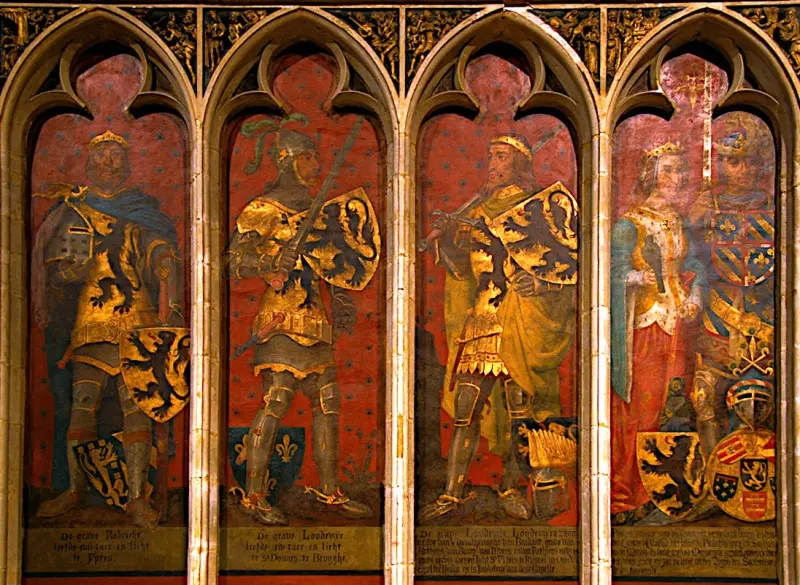
The chapel owes its name to the niches containing painted portraits of the counts of Flanders, which was a (relatively) independent principality from the 9th to the early 15th century.
It subsequently became part of the Burgundian and Habsburg Netherlands. When the French annexed the county in 1795, it was abolished.
The Church of Our Lady was originally part of the count’s castle that Baldwin IX had built in Kortrijk in the early 13th century. At that time, the city was an important textile center. One of his successors, Count Guy of Dampierre, became embroiled in a conflict with the French king Philip the Fair. Around 1300, the French conquered Kortrijk and expanded the count’s castle into a so-called fortress, surrounded by a defensive moat. Traces of that castle can still be seen on the exterior of the Count’s Chapel.
The French fortress played a major role in the Battle of the Golden Spurs on July 11, 1302. The battle was fought on the Groeningekouter, right in front of the fortress. The battle became legendary in the 19th century, largely thanks to the popular novel*The Lion of Flanders*by Hendrik Conscience. Conscience took creative liberties with historical reality: His“Lion of Flanders,”Robert of Béthune, the son of Count Guy, was not actually present at the Battle of the Golden Spurs.
This story was created by Geheugen Collectief for FAAM – Virtual Museum.
 ErfgoedApp
 ErfgoedApp
 ErfgoedApp