In the past, if you wanted to know what time it was, it was best to look up at the sky first. At exactly noon, the sun is in the south, at its highest point of the day. It is then directly above the meridian of the place where you are standing. The meridian is an imaginary line running from the North Pole to the South Pole, connecting all the places where it is exactly noon. At 12:00 p.m., shadows point directly north. Sundials—a type of timepiece used as far back as ancient Egypt—work according to this principle.
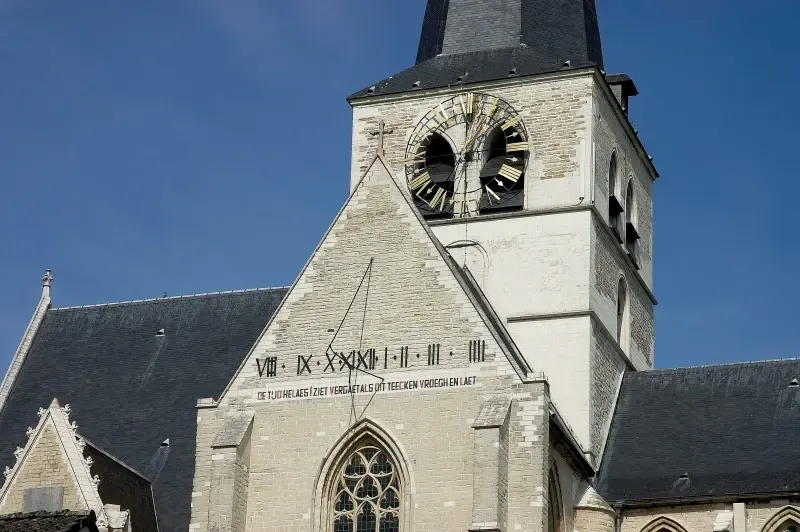
One of the largest sundials in Flanders is mounted on the Church of Our Lady in Huldenberg, in Flemish Brabant. It was installed on the southern side chapel of the Gothic church in 1764. Beneath the hours, marked in Roman numerals, is an inscription:“Alas, time! See how it passes, as this sign shows, early and late.” A reminder to the residents of Huldenberg that their earthly lives are fleeting.
Mechanical timepieces first appeared in Europe around 1300. They worked even in bad weather, but you still needed a sundial to set the time.
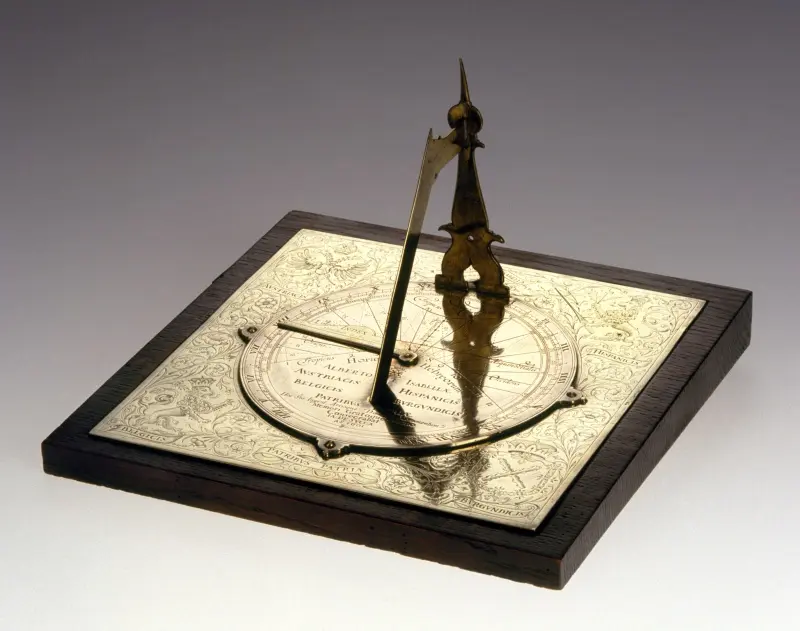
At the same time in the afternoon everywhere in Flanders?
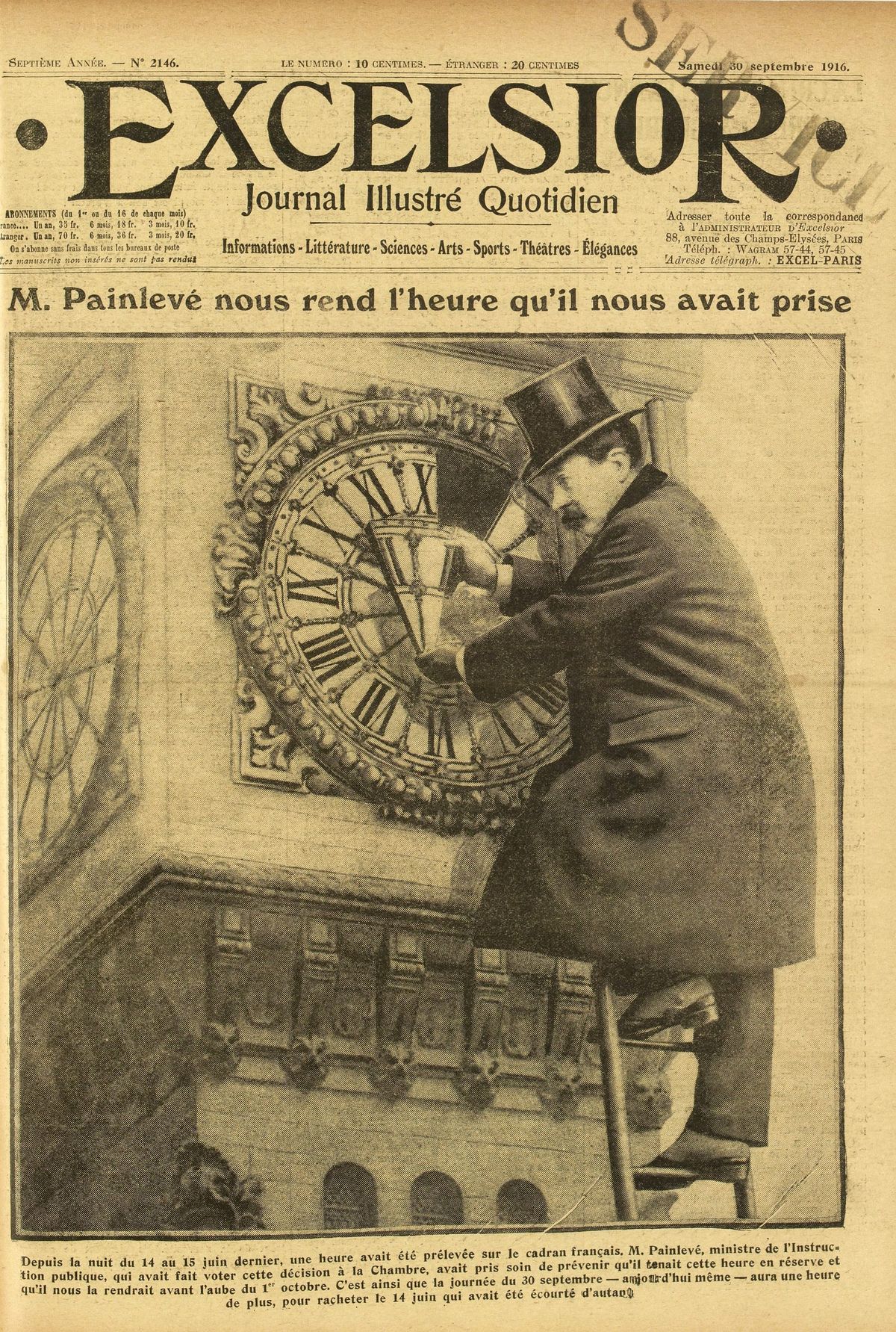
Solar time varies from place to place. Until the late 19th century, people in Belgium used local time. Before that, they relied on the tower clock and the clocks in their village or town. It wasn’t until 1892 that a standard time was introduced in Belgium. A few years earlier, a conference in Washington, D.C., had divided the world into time zones, based on Greenwich Mean Time (GMT). Geographically speaking, Belgium actually lies within that time zone, but for political, commercial, and practical reasons, the country switched to the Central European Time (CET) zone—GMT +1 hour—after World War II.
So before you sell your watch and invest in a sundial, you should know that “true solar time” is not the same as official time. In Flanders, official time is ahead of solar time.
This story was created by Geheugen Collectief for FAAM – Virtual Museum.
 ErfgoedApp
 ErfgoedApp
 FAAM
FAAM
 FAAM
FAAM
 FAAM
FAAM
 FAAM
FAAM